When we're running around the woods, playing and having fun it's easy to forget that many children do not have the opportunity to do so because they are a 'young carer'.
Young carers are children and young people who look after someone in
their family who has a disability, a long term illness, or is affected
by mental ill health or substance misuse. Young carers may look after parents, care for a brother or sister, or
other relative. The average age of a young carer is 12 and they take on
responsibilities normally only expected of an adult.
Research indicates that 1:12 young people in UK secondary schools are
either impacted by family ill health or carry a caring responsibility. This means that their childhood is far from carefree.
This month we teamed up with Flamingo Foundation for a day of adventure for young carers in Bristol.
We spent the day in the woods, running around playing 'coo-ee', discovering hiding places and new trees, learning to light fires safely, cooking our lunch over an open fire and, of course, stuffing our faces with sausages, popcorn and marshmallows (although not all at the same time)
We had such a good time, more are planned for 2015 so watch this space!
Wednesday, 27 August 2014
Thursday, 7 August 2014
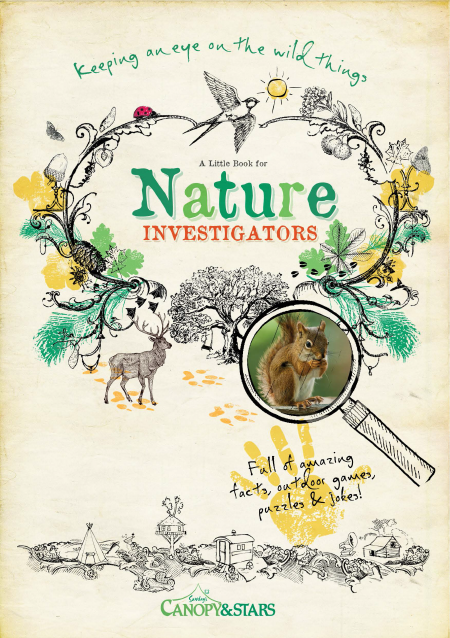
A Little Book for Nature Investigators
This Summer I was invited to write the foreword for Canopy & Star's Little Book for Nature Investigators.
This lovely little booklet is for all budding Nature Investigators who
enjoy exploring the wild outdoors. There are four packs full of amazing
facts, games, puzzles and jokes plus the Nature Investigators Passport
to keep track of your progress. What's more, if you post your
finished passport to Canopy & Stars, they'll send you a Brilliant Certificate of Completion!
Here's how to get hold of the book and start investigating:
1. Print out the whole book in landscape format. The pages ordered for fun foldy booklet making OR
2. Download the whole book to view on screen (take it with you on your tablet) OR
3. Print or download the Nature Investigators Passport for any budding Investigators who might want their own.
Wednesday, 16 July 2014
We don't have time to educate our children...
There' so much focus on connecting children with nature; school initiatives such as Eco-Schools, Natural Connections and small changes to the secondary National Curriculum, national campaigns such as Project Wild Thing, and a plethora of initiatives at local level such as the Bristol Festival of Nature, Forest Schools (including mine) and the work of the Wildlife Trusts.
That's not to say that all these wonderful ideas aren't worthwhile. Indeed, children nowadays are arguably more knowledgeable on issues of sustainability than their parents. And therein lies the problem.
We simply don't have the time to wait for our knowledgeable progeny to grow up and save our planet.
Bill Oddie, in last month's BBC Nature Magazine, argues that 'the health, protection and management of the environment is not kids' work. It is adults who make the laws, pollute the land and sea, inflict death and cruelty, and it is only adults who have the power to make things better. Providing environmental education for our children is clearly laudable, but relying on the next generation to save the planet is complacent, unfair, irresponsible and unwise.' And I couldn't agree more.
There are currently 4,554 species classed as 'critically endangered' on the IUCN list of Threatened Species and 6,807 classed as 'endangered'.
Endangered.
Meaning 'at risk of extinction'.
And as the saying goes, extinction is forever.
Almost all of these are due to human activity, especially habitat destruction, and it is not just the actions of a few illegal loggers in far-flung rainforests that threaten the survival of so many species. It is the everyday actions of you and me that produce the consumer demand that fuels the industries that are destroying out planet: the cars we drive, the flights we take, the electricity we consume, the toilet paper we choose to buy, the food we eat and the technology we use and discard the minute the latest model comes out.
Our desire for the latest mobile phone drives demand for coltan, a key mineral used in mobile phone technology, that is illegally mined in areas of the Democratic Republic of Congo. This results in the erosion of land, pollution of waterways and has a devastating effect on the ecology of the region, including destroying the habitat of the eastern mountain gorilla. This species is critically endangered. There are only 850 individual mountain gorillas left in the wild. It is adults who buy technology, so it is adults who need to be educated about the consequences of their actions.
On the other side of the world, the number of Sumatran orangutans left in the wild is decreasing rapidly. It is estimated that they will disappear within the next five to ten years. That's at least ten years before any of my friends' children will have the skills, education or influence to change a thing. And by then it will be far too late.
But all is not lost. Yet. Simple actions, such as the choice of biscuits you buy, could prevent the extinction of the orangutan.
Indonesia is the largest producer of palm oil, a high yield crop that is used in everything from biscuits and bread to shampoo and cleaning products, demanded by people like you and me. The average Westerner will consume ten kilos of palm oil in a single year. Yes, even if you buy organic. Palm oil plantations are destroying both primary and secondary rainforests at an alarming rate. All so that you and I can have cheap biscuits and shiny hair. Even 'sustainable' palm oil is questionable, but that's for another blog. The point is, that without knowing it, many of us are contributing to the permanent destruction of a keystone species and all the less exciting plants and animals that form part of the same ecosystem. All for a biscuit or a loaf of bread that we can't be bothered to make ourselves.
And those are just a couple of decisions that you and I get to make. I've not even touched upon the law-makers, heads of industry, all those with unfathomable power that choose to put profit before planet.
We need to be selfish. Stuff the kids. With increasing life expectancy and decreasing time-scales of extinction, unspeakable things are going to happen in our own lifetime. In fact, maybe even before you move to your next house, or change your current job. Education and learning is not just for children. We need to take an interest in our natural world and how our own consumption affects it. We need to be accountable for our own learning and seek out the facts about the state of our planet. We don't sit in classrooms all day and get fed information so we need to do it ourselves.
We need to question, take responsibility and change. The future of our planet is in our hands, not those of our children.
That's not to say that all these wonderful ideas aren't worthwhile. Indeed, children nowadays are arguably more knowledgeable on issues of sustainability than their parents. And therein lies the problem.
We simply don't have the time to wait for our knowledgeable progeny to grow up and save our planet.
Bill Oddie, in last month's BBC Nature Magazine, argues that 'the health, protection and management of the environment is not kids' work. It is adults who make the laws, pollute the land and sea, inflict death and cruelty, and it is only adults who have the power to make things better. Providing environmental education for our children is clearly laudable, but relying on the next generation to save the planet is complacent, unfair, irresponsible and unwise.' And I couldn't agree more.
There are currently 4,554 species classed as 'critically endangered' on the IUCN list of Threatened Species and 6,807 classed as 'endangered'.
Endangered.
Meaning 'at risk of extinction'.
And as the saying goes, extinction is forever.
Almost all of these are due to human activity, especially habitat destruction, and it is not just the actions of a few illegal loggers in far-flung rainforests that threaten the survival of so many species. It is the everyday actions of you and me that produce the consumer demand that fuels the industries that are destroying out planet: the cars we drive, the flights we take, the electricity we consume, the toilet paper we choose to buy, the food we eat and the technology we use and discard the minute the latest model comes out.
Our desire for the latest mobile phone drives demand for coltan, a key mineral used in mobile phone technology, that is illegally mined in areas of the Democratic Republic of Congo. This results in the erosion of land, pollution of waterways and has a devastating effect on the ecology of the region, including destroying the habitat of the eastern mountain gorilla. This species is critically endangered. There are only 850 individual mountain gorillas left in the wild. It is adults who buy technology, so it is adults who need to be educated about the consequences of their actions.
![]() |
| an orangutan with nowhere to go |
On the other side of the world, the number of Sumatran orangutans left in the wild is decreasing rapidly. It is estimated that they will disappear within the next five to ten years. That's at least ten years before any of my friends' children will have the skills, education or influence to change a thing. And by then it will be far too late.
But all is not lost. Yet. Simple actions, such as the choice of biscuits you buy, could prevent the extinction of the orangutan.
Indonesia is the largest producer of palm oil, a high yield crop that is used in everything from biscuits and bread to shampoo and cleaning products, demanded by people like you and me. The average Westerner will consume ten kilos of palm oil in a single year. Yes, even if you buy organic. Palm oil plantations are destroying both primary and secondary rainforests at an alarming rate. All so that you and I can have cheap biscuits and shiny hair. Even 'sustainable' palm oil is questionable, but that's for another blog. The point is, that without knowing it, many of us are contributing to the permanent destruction of a keystone species and all the less exciting plants and animals that form part of the same ecosystem. All for a biscuit or a loaf of bread that we can't be bothered to make ourselves.
And those are just a couple of decisions that you and I get to make. I've not even touched upon the law-makers, heads of industry, all those with unfathomable power that choose to put profit before planet.
We need to be selfish. Stuff the kids. With increasing life expectancy and decreasing time-scales of extinction, unspeakable things are going to happen in our own lifetime. In fact, maybe even before you move to your next house, or change your current job. Education and learning is not just for children. We need to take an interest in our natural world and how our own consumption affects it. We need to be accountable for our own learning and seek out the facts about the state of our planet. We don't sit in classrooms all day and get fed information so we need to do it ourselves.
We need to question, take responsibility and change. The future of our planet is in our hands, not those of our children.
Monday, 26 May 2014
How to make a shoogler
If you want to be able to make popcorn in the woods, then you're going to need a shoogler. Here's how to make one...
2 identical sieves
a long pole (I use hazel)
a sharp knife
pliers
the ring from an old keyring
wire cutters
2 pieces of wire (one long, one short)
pruning saw (I use a Laplander)
Use the pruning saw to make a stop cut, about half a centimetre deep, on one end of the pole, the same distance from the end of the stick as the length of one of the sieve handles.
Use the knife to split the pole down to the stop cut, taking off about half a centimetre, making the pole flat on one side.
On the opposite side of the pole, at the same end, use the knife to cut two small notches. These will stop the wire from slipping. Cut one as near to the end as you can, cut the other about a centimetre higher than the stop cut on the other side.
Twist one end of the wire onto the bottom of one of the sieve handles. Then attach the sieve to the flat side of the pole by wrapping the long piece of wire around both the handle and the pole as tightly as you can. Wind the wire upwards towards the end of the pole, using the notches, and secure.
Make sure there are no sharp bits sticking out.
Join the round ends of the two sieves together using the old keyring. You will have to force it through the mesh and an old piece of wire can be used to make the holes bigger before putting it on.
Make sure you have the sieves both facing upwards otherwise it won't work!
At the top of the handle of the second sieve, secure the short piece of wire.
Bend the free end over onto itself so that it isn't sharp.
You now have your very own shoogler!
When you want to make popcorn, open the shoogler and add oiled popcorn kernals. Secure shut making sure the sieves are as close together as possible (if there are any gaps the popcorn flies out).
Hold the shoogler above the embers of a campfire or BBQ. If you're impatient and you hold it over flames, this will happen:
Allow the metal on the shoogler to cool before diving in and stuffing your face.
Happy shoogling!
Wednesday, 14 May 2014
10 incredible reasons you should get behind my crowdfunding project,with unbelievable pictures of cats. #7 is truly shocking.
Yes, that’s how you’re expected to write headlines nowadays.
And apparently it works as you’re reading this now. So you may as well carry on
and read the rest. And, yes, there will be pictures of cats. Well, one cat a
number of times. But he is cute.
Back to my crowdfunding project.
1. It’s risk free.
You make a pledge and the money is only taken if enough people do the same and
the target is met. That way you won’t pay out on an idea that’s a dud. Which mine isn’t.
![]() |
| Risk free means you can sleep easy |
2. You don’t have to
pay a fortune. Pledges are tiered so that you can spend as much or as little
as you want. Found some loose change down the back of the sofa? Great, pledge a
fiver. Numbers come up on the premium bonds? - does anyone own them anymore? -
Fab, splash out and make my day.
![]() |
| Told you he was cute |
3. You get something
back. Each pledge receives a reward. It might be just a great big thank you
and a warm fuzzy feeling for a fiver, or a one of a kind hand-crafted work of
art made by someone wonderful if you pledge more. Or anything in between. There
are lots to choose from so have a look and make a pledge.
![]() |
| He was going to save the world but got stuck in a veg box |
4. You can get things
that money can’t buy. Like the aforementioned work of art, or DVDs signed
by the director, books signed by the author, that sort of thing.
![]() |
| Money can't buy Cat Buckaroo |
5. You can make a
difference. And you can do this with not much money and without leaving the
house, or even getting up. That’s the great thing about it.
![]() |
| You can even pledge from this position |
6. You can help out
the little guys. Great ideas rarely come from big companies. They come from
inspired individuals, like me, who don’t have many options open to them in
terms of financial support. I wonder how many more amazing things would be out
there if more people crowdfunded?
![]() |
| Pledging feels this good |
7. This cat likes
knitting (told you it was socking). He’s not very good but he enjoys it. It
relaxes him. He says he’ll pledge £10 if you do.
![]() |
| It's a scarf apparently |
8. You can invest in
people who are passionate about what they do. Crowdfunding isn’t the easy
option. It’s lots of hard work even before the project is launched. And then
some. Now it’s up and running it’s even more hard work so if I didn’t truly
believe that my project was worth doing, I would never have got this far.
![]() |
| So, so passionate |
9. You’ll have something exciting to talk
about. The whole point of crowdfunding is to get people excited about the
project. If you’ve pledged you have to talk about it and encourage others
to do the same. You can share it on Facebook, tweet about it, email your
friends. For 42 days you’ll have something really cool to talk about. I have friends who check my Crowdfunder total more than I do. They seem to be enjoying
themselves.
![]() |
| He's so excited he's fallen asleep in a pizza box |
And finally…
10. You can say ‘no!’ to borrowing.
Ha! We're free! Now we don’t have to beg anyone to allow us to pay vast amounts of interest on money that doesn’t really exist. ‘Cos now we’ve got
crowdfunding. So there.
![]() |
| If he had fingers he'd be sticking one up |
Click here to make a pledge on my crowdfunder project. Go
on. I showed you cute cat pictures. Do it.
Monday, 21 April 2014
What is crowdfunding?
On Tuesday 22nd April, at midday, I will be launching my crowdfunding campaign for Go Wild Nature Kits.
But what is crowdfunding?
In short, as the name suggests, crowdfunding involves raising a certain amount of money for a project through a large number of people pledging small amounts of cash within a given number of days (42 in my case). The 'crowd' pledge money in exchange for rewards, via the web. It's the exact opposite of going to a bank and asking for the whole lot from one investor.
A lot of crowdfunding initiatives are 'all or nothing' (such as mine) which means that if the project does not meet its target by the deadline, i.e. not enough people make pledges to meet the target, there will be no money and no one pays anything. If enough people make pledges and the target is met, everyone pays what they pledged. This means that only projects that have a lot of support from their community will be funded. It also means that both project owners and backers have to tell people they know that it's a great idea, via social media and word of mouth, so that the campaign gathers momentum and more people get to know about it.
All very straight forward, right? Yes, but if you're in my shoes right now, that doesn't stop it being, quite simply, really daunting.
The idea that I am about to stand up in front of all my family and friends, colleagues and clients, and tell them that I've had a great idea and that I need their help makes me feel a little bit wobbly. I need people to agree with me, to back me with a donation and to then tell everyone about it. If it works, then great, I don't mind everyone knowing. BUT, if I fail to meet my target then everyone I know will know that I've failed.
<iframe allowfullscreen="" frameborder="0" height="270" src="//www.youtube.com/embed/RXMnDG3QzxE" width="480"></iframe>
If you haven't seen Derek Sivers' TED talk about How to Start a Movement then I suggest you do. It's a short and amusing talk and in it he uses a clip of one man at a festival dancing wildly on his own in the middle of a field to demonstrate how ideas catch on. Until another festival goer joins him, the dancing man is just a lone nut doing something that no one else is. When the second person arrives and joins in, it validates the lone nut and people begin to think that maybe he's not so crazy/drunk after all. Once a couple more people start dancing, they begin to look pretty cool and eventually there is a whole group of people in that field dancing wildly. So much so that many of those who aren't dancing begin to feel like they should be and join in too.
This is a perfect example of the law of diffusion of innovation. Put very, very simply, new ideas spread through a small number of people adopting an idea early on and telling others how great the idea is. This makes others investigate, adopt and do the same. Eventually, if you're not doing it, you're not cool. Unsurprisingly, this is exactly how crowdfunding works too.
At the moment, I feel like a lone nut dancing wildly in a field. The music is great and my dance moves are like nothing you've ever seen before. I need some people to join me and start dancing too. Eventually, with enough people, we'll be so cool that everyone else will want to do it too.
www.crowdfunder.co.uk/gowild (live from midday on 22nd April)
But what is crowdfunding?
In short, as the name suggests, crowdfunding involves raising a certain amount of money for a project through a large number of people pledging small amounts of cash within a given number of days (42 in my case). The 'crowd' pledge money in exchange for rewards, via the web. It's the exact opposite of going to a bank and asking for the whole lot from one investor.
A lot of crowdfunding initiatives are 'all or nothing' (such as mine) which means that if the project does not meet its target by the deadline, i.e. not enough people make pledges to meet the target, there will be no money and no one pays anything. If enough people make pledges and the target is met, everyone pays what they pledged. This means that only projects that have a lot of support from their community will be funded. It also means that both project owners and backers have to tell people they know that it's a great idea, via social media and word of mouth, so that the campaign gathers momentum and more people get to know about it.
All very straight forward, right? Yes, but if you're in my shoes right now, that doesn't stop it being, quite simply, really daunting.
The idea that I am about to stand up in front of all my family and friends, colleagues and clients, and tell them that I've had a great idea and that I need their help makes me feel a little bit wobbly. I need people to agree with me, to back me with a donation and to then tell everyone about it. If it works, then great, I don't mind everyone knowing. BUT, if I fail to meet my target then everyone I know will know that I've failed.
![]() |
| 'lone nut' |
<iframe allowfullscreen="" frameborder="0" height="270" src="//www.youtube.com/embed/RXMnDG3QzxE" width="480"></iframe>
If you haven't seen Derek Sivers' TED talk about How to Start a Movement then I suggest you do. It's a short and amusing talk and in it he uses a clip of one man at a festival dancing wildly on his own in the middle of a field to demonstrate how ideas catch on. Until another festival goer joins him, the dancing man is just a lone nut doing something that no one else is. When the second person arrives and joins in, it validates the lone nut and people begin to think that maybe he's not so crazy/drunk after all. Once a couple more people start dancing, they begin to look pretty cool and eventually there is a whole group of people in that field dancing wildly. So much so that many of those who aren't dancing begin to feel like they should be and join in too.
This is a perfect example of the law of diffusion of innovation. Put very, very simply, new ideas spread through a small number of people adopting an idea early on and telling others how great the idea is. This makes others investigate, adopt and do the same. Eventually, if you're not doing it, you're not cool. Unsurprisingly, this is exactly how crowdfunding works too.
At the moment, I feel like a lone nut dancing wildly in a field. The music is great and my dance moves are like nothing you've ever seen before. I need some people to join me and start dancing too. Eventually, with enough people, we'll be so cool that everyone else will want to do it too.
www.crowdfunder.co.uk/gowild (live from midday on 22nd April)
Monday, 10 March 2014
Shoogling: the best way to make popcorn in the woods
If I'm making popcorn and it's not on a campfire, along with writing posts about how to make it on said campfire, it must mean that I'm avoiding doing some kind of boringsittingstill admin or something. And indeed I am, in fact, I'm writing the terms and conditions of my Easter Forest School Course. It's thrilling.
So how do you make popcorn on a campfire? Easy-peasy, you just need to make yourself a specialist piece of equipment known as a shoogler. Thank Lily for introducing us to that term (and it always has to be written in bold italics where possible). Shoogling means 'to shake, sway or rock back and forth'. Which is exactly how you make popcorn in a shoogler.
How to make a shoogler:
The first thing you need is a big stick, think 'fat broomstick stick', hazel is best as it's straight and likes being cut down, but ash or sycamore are good too.
Then you need two metal sieves. You also need some metal wire. The metal bit is very important.
Once you've realised how expensive metal sieves are nowadays, and that you've had to buy two, place them one on top of the other so that they create a sphere, with the handles lined up. This bit is really hard to describe so I'm just going to cheat and show you a picture of the finished article. That'll save me a lot of words.
Hinge the two sieves together using the wire. Use the wire again to attach ONE of the sieve handles to the big stick of hazel that you cut when I told you to earlier. Cutting a small notch in the stick will stop your wire from slipping off.
Use your imagination and ingenuity to create some kind of wire fastening to keep the second sieve handle attached to the big stick once the popcorn is inside.
And - ta da! - you've got your very own shoogler. All you need now are some popcorn kernels, a bit of oil (I usually put some kernels in a cup, pour a little oil over them and give them a good shake), and a fire that has burnt down to embers (try it on a high flame, it's fun, popcorn burns well and flaming shooglers look great!).
Hold the shoogler over the fire and shoogle, shoogle SHOOGLE until all the corn is popped. The popcorn will have a lovely smokey flavour and won't need salt, sugar or any other flavouring.
Plus, if you're in the woods, you won't think that melting a huge chunk of salted butter over the top is a great idea. And then do it and eat the lot.
Like I've just done...
So how do you make popcorn on a campfire? Easy-peasy, you just need to make yourself a specialist piece of equipment known as a shoogler. Thank Lily for introducing us to that term (and it always has to be written in bold italics where possible). Shoogling means 'to shake, sway or rock back and forth'. Which is exactly how you make popcorn in a shoogler.
How to make a shoogler:
The first thing you need is a big stick, think 'fat broomstick stick', hazel is best as it's straight and likes being cut down, but ash or sycamore are good too.
Then you need two metal sieves. You also need some metal wire. The metal bit is very important.
Once you've realised how expensive metal sieves are nowadays, and that you've had to buy two, place them one on top of the other so that they create a sphere, with the handles lined up. This bit is really hard to describe so I'm just going to cheat and show you a picture of the finished article. That'll save me a lot of words.
![]() |
| This is the point at which I realise that I am always so busy in the woods that I rarely manage to take any decent photos of anything. So I've borrowed this very informative image from here. |
Hinge the two sieves together using the wire. Use the wire again to attach ONE of the sieve handles to the big stick of hazel that you cut when I told you to earlier. Cutting a small notch in the stick will stop your wire from slipping off.
Use your imagination and ingenuity to create some kind of wire fastening to keep the second sieve handle attached to the big stick once the popcorn is inside.
And - ta da! - you've got your very own shoogler. All you need now are some popcorn kernels, a bit of oil (I usually put some kernels in a cup, pour a little oil over them and give them a good shake), and a fire that has burnt down to embers (try it on a high flame, it's fun, popcorn burns well and flaming shooglers look great!).
Hold the shoogler over the fire and shoogle, shoogle SHOOGLE until all the corn is popped. The popcorn will have a lovely smokey flavour and won't need salt, sugar or any other flavouring.
Plus, if you're in the woods, you won't think that melting a huge chunk of salted butter over the top is a great idea. And then do it and eat the lot.
Like I've just done...
Subscribe to:
Comments (Atom)