Thursday, 18 June 2015

Wild Women


I’ve suspected for a while that if you put a bunch of women into a woodland together then amazing things will happen. I suppose that over the years of running about in the woods with people of all ages, I’ve realised that when women manage to get into the wild there a few things that are quite common: lack of confidence, thinking that outdoors is macho, thinking they won’t be able to ‘do’ it, the belief that outdoor skills are hard.

Thing is, it’s not. There’s actually nothing macho or difficult about firelighting. Although, if you believe the internet or the telly, it’s really complicated and you need to be as rough as guts to achieve anything. Then again, if you believe the internet or the telly…

Occasionally I’ll check out a survival course online or dip into a bushcraft forum and it’s all about the kit and the khaki and the ‘challenge‘ and even I feel intimidated. And I know what I’m doing. So how would a woman who knew nothing about that kind of thing feel? My guess is, she’d run a mile.

Wonder Women Bushcraft
So finally, last September, I got the chance to find out what happens when a group of women gather in the woodlands together when I ran the Wonder Women Bushcraft weekend. No, we didn’t get naked, no we didn’t giggle and talk about boys and no, and you can’t watch (a common request). What happened, right from the start, was that an incredibly supportive and relaxed environment materialised. The age range was twenty-four to sixty-six and everyone managed to light a fire. Easily. And then some.

The women learnt about firewood and different firelighting techniques, and about knifework and tool safety and all the way through they supported and encouraged each other and everyone flourished. I watched as confidence soared, skills were mastered and friendships were formed. The words ‘empowered’ ‘confident’ and ‘self-assured’ floated about over cups of tea by the campfire. It wasn’t about what people were wearing, how they looked or what they had done before. It was about women doing things for themselves, sharing in experiences and stepping off of the treadmill of life.
It was lovely but as I stared at the Waitrose olives and the M&S biscuits, a massive part of me wanted to know if it would be the same if we gathered together a group of women who would never get the chance to do such a thing. What would happen? Would it be any different?

Nine months later and we are 2 weeks into a 6 week pilot project with women from the Bristol Drugs Project. These women are at various stages in their journey to recovery from drug and alcohol misuse. Their lives are messy, there is often violence and they have never been offered the opportunity to do something like this. There is simply nothing along these lines for women, by women.

I have an inkling into what life is like for these women but in reality I have no idea. I’m not interested in whatever label they have been given. I don’t like labels, they encourage preconceptions, whether helpful or not, and quite often what is really underneath the label is a human being who is a little bit lost. It could so easily be you or I. Luckily, there are no labels in the woods, which is what makes it such a restorative place to spend time. Without labels we can’t prejudice, even inadvertently.

In the two sessions that we have spent in the woods we have learnt firelighting, cooked over the campfire, learnt about trees and birdsong. There is a sense of achievement, a sense of camaraderie and a break from the challenges of daily life. The only challenges that are presented to them are ones that are surmountable and fun. 

I have an amazing team of talented, compassionate and dazzling ladies to back me up: Emma, Bec and Nikki who each have their skills and talents and care about this as much as I do. The thought that this will have to come to an end, due to lack of funding, is terrifying. There’s so much to achieve and we already know that we are making a difference. Getting women into woodlands is so empowering, and we will do everything we can to continue. This project is part of my goal to change the perception of women in woodlands. I want to de-macho and demystify the great outdoors and, by doing so, show women that we are capable of enjoying all of the tranquillity and beauty that Nature has to offer.

Friday, 22 May 2015

Feast in the woods and dawn raids


I'm off! To Feast in the Woods. Exactly as it sounds. Dawn raid Sunday morning. 5am. Didn't think that through...

I'm hoping it lives up to the photos on its website!


Friday, 24 April 2015

National Play Champions

Go Wild are National Play Champions! How exciting! It's all to do with National Children's Day which is on the 17th May.  

Apparently 'Play Champions are children’s centres, playgroups, schools and other settings where children find space and time for play of all kinds – creative, exploratory, imaginative, deep play, rough and tumble play, role play, mastery play – any type of play that involves children's natural creativity and being able to do lots of things without needing to focus on specific, pre-determined outcomes'. Which is a complicated way of saying that Play Champions give children the time and space to explore, create, discover, delve into their imaginations and have fun without telling them what to do... or being scared that they're not learning.

I think the same applies to adults too. 

Monday, 20 April 2015

Woohoo! Nature Kits are go!

Take a look at that right there! That's a labour of love that is. After a year of fundraising and planning and writing and spending days and days trawling the internet for a box that was made of recycled materials, the first Go Wild Nature Kit is ready to go! Woohoo!

To be honest, I'm sick of the sight of them at the moment but I'm sure in a couple of weeks I'll feel quite pleased with myself. And my friends. I really do know some talented people who have helped me in all kinds of ways on this journey. Thank you, you lot. You know who you are.

Next step is to get widgets and stuff onto the website so people can buy them. Watch this space!

Thursday, 9 April 2015

Focaccia on a campfire

Just take a look at that! That's a rather yummy focaccia that one of my level 3 Forest School trainees made on the campfire this afternoon. There was spelt bread too. And banana bread.

On a separate course, somehow we came up with making bread in a bag and it's all too simple and easy not to share! Read on to find out how to make bread when you're outdoors without getting your hands all sticky.


 To make the bread mix you will need:
  • 500g strong white flour
  • 5g dried yeast
  • 10g fine salt
  • 1 tbsp olive oil
  • 325ml water
  • Semolina flour for cooking
  • Extra salt and oil for finishing
  • A sturdy, sealable food bag (Ikea do great ones)
  • Some kind of water bottle
Method:

  1. DO THIS BIT AT HOME. Put all the dry ingredients into the food bag.
  2. Put the wet ingredients into a water bottle. Go camping.
  3. Once you get where you're going and decide that it's time to start the bread mix off get someone to light a fire and then pour the wet ingredients into the dry ingredients and seal the bag with that little clicky thing at the top, pushing out as much air as possible.
  4. Knead the bread mix through the bag. Give it to the kids, or someone else. It's a lot less boring when you're sat by a fire. You need to do this for about 10 minutes.
  5. Put the bag somewhere warm for an hour or so. Put it under a coat, or in a sleeping bag, or just somewhere off the ground. Remember to check it occasionally to make sure it doesn't explode!
  6. Meanwhile, once the fire has got some good embers going, preheat your oven' by putting the casserole onto the embers and put a few on the top and leave for at least an hour.
  7. Once the bread dough has risen and the oven is hot, open the bag and knock back the dough.
  8. Take the casserole off the fire and remove the lid. Dust the bottom with semolina flour so that the bread dough won't stick. If it goes black instantly your oven is too hot. Tip it out, wait a little and then try again.
  9. Pour the bread dough straight into the casserole, spread out with your fingers and make those little dimples. Sprinkle with posh salt and drizzle with olive oil then put the lid on and put it back into the embers.
  10. Put embers back onto the top of the casserole and leave for about 20 minutes, turning the pot around every 5 minutes to get an even bake.

And at the end of that you should have a lovely loaf of focaccia to munch. If not, it's a good excuse to light a fire and try again!


You will need:
  • A cast iron casserole or dutch oven (with lid)
  • Bread mix
  • Water bottle with oil and water in it

Tuesday, 25 November 2014

Dinner under a dinosaur


Not just any old dinosaur, the dinosaur! You know, the one in the National History Museum in London. At night.

And it wasn't just any old meal, it was a Michelin starred meal and it was bloomin' tasty! And a little bit surreal.

It's not often (read: ever) that I get to do anything like that but this was all due to the Paw Prints project we did last week. As I said in that post, it was part of a larger project by Synchronicity Earth to commemorate 50 years of the IUCN Red List. We were in the Natural History Museum for the Biophilia Ball. Have a look below to hear Jessica Sweiden's speech (clever organising lady).


Friday, 21 November 2014

Go Wild has gone international!

Muddy leaf art in Bristol
Go Wild has gone international! This week, we've been out in the woods EVERY DAY with a class of Year 5 pupils from Luckwell Primary School in Bristol taking part in the Paw Prints project. The cool thing about this project (apart from the amount of 'Wild Time' we've been getting) is that three other schools have been doing the same activities on the same day - and two of those schools were in DIFFERENT COUNTRIES!

Grassy leaf art in London
So while we've been messing about in the muddy woods in Bristol and another school in London has been carrying out activities in their local, grassy park, a group of students in Tampere, Finland have been braving the cold and the ice, while children in Mogan, Gran Canaria have been doing the same activities in shorts and T-shirts!

Chilly smelly cocktails in Finland
The less glamorous side of things is the weeks of planning that have gone into producing lesson plans that work in different seasons, climates and habitats while still teaching the children about ecosystems, using all of their senses. I love a challenge and I enjoyed every minute of it!

Activities included recording sound postcards in the dark, making mud faces on trees, creating ephemeral leaf art, meeting trees, making smelly cocktails... The children then uploaded photos that they had taken of the activities onto a website that had been created for the project and had a look at what the other schools had been doing.

Hot smelly cocktails in Gran Canaria
This project was run as a part of a larger initiative from Synchronicity Earth to mark 50 years of the IUCN Red List of Threatened Species. The aim was to inspire the next generation of environmental custodians by getting them to explore and understand their local ecosystems.

If you would like to have a go yourself, whether you are a teacher or a parent, you can download the lesson plans from the Paw Prints Website.


Wednesday, 27 August 2014

Young Carers Go Wild

When we're running around the woods, playing and having fun it's easy to forget that many children do not have the opportunity to do so because they are a 'young carer'.

Young carers are children and young people who look after someone in their family who has a disability, a long term illness, or is affected by mental ill health or substance misuse. Young carers may look after parents, care for a brother or sister, or other relative. The average age of a young carer is 12 and they take on responsibilities normally only expected of an adult.

Research indicates that 1:12 young people in UK secondary schools are either impacted by family ill health or carry a caring responsibility. This means that their childhood is far from carefree.

This month we teamed up with Flamingo Foundation for a day of adventure for young carers in Bristol.

We spent the day in the woods, running around playing 'coo-ee', discovering hiding places and new trees, learning to light fires safely, cooking our lunch over an open fire and, of course, stuffing our faces with sausages, popcorn and marshmallows (although not all at the same time)
 
We had such a good time, more are planned for 2015 so watch this space!


Thursday, 7 August 2014

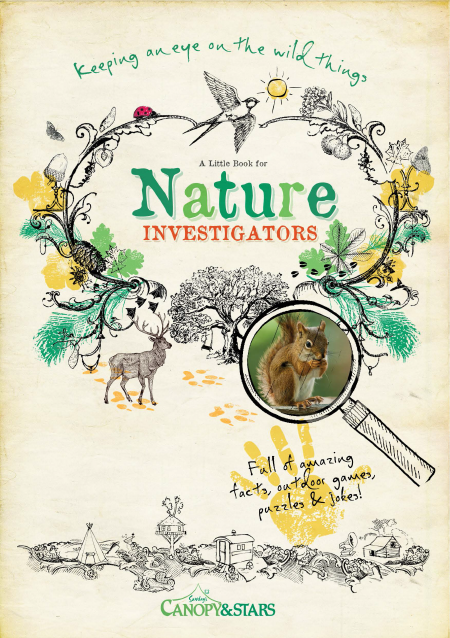
A Little Book for Nature Investigators

This Summer I was invited to write the foreword for Canopy & Star's Little Book for Nature Investigators.

This lovely little booklet is for all budding Nature Investigators who enjoy exploring the wild outdoors. There are four packs full of amazing facts, games, puzzles and jokes plus the Nature Investigators Passport to keep track of your progress. What's more, if you post your finished passport to Canopy & Stars, they'll send you a Brilliant Certificate of Completion!

Here's how to get hold of the book and start investigating:  
1. Print out the whole book in landscape format. The pages ordered for fun foldy booklet making OR
2. Download the whole book to view on screen (take it with you on your tablet) OR
3. Print or download the Nature Investigators Passport for any budding Investigators who might want their own.

Wednesday, 16 July 2014

We don't have time to educate our children...

There' so much focus on connecting children with nature; school initiatives such as Eco-Schools, Natural Connections and small changes to the secondary National Curriculum, national campaigns such as Project Wild Thing, and a plethora of initiatives at local level such as the Bristol Festival of Nature, Forest Schools (including mine) and the work of the Wildlife Trusts.


That's not to say that all these wonderful ideas aren't worthwhile. Indeed, children nowadays are arguably more knowledgeable on issues of sustainability than their parents. And therein lies the problem.

We simply don't have the time to wait for our knowledgeable progeny to grow up and save our planet.

Bill Oddie, in last month's BBC Nature Magazine, argues that 'the health, protection and management of the environment is not kids' work. It is adults who make the laws, pollute the land and sea, inflict death and cruelty, and it is only adults who have the power to make things better. Providing environmental education for our children is clearly laudable, but relying on the next generation to save the planet is complacent, unfair, irresponsible and unwise.' And I couldn't agree more.


There are currently 4,554 species classed as 'critically endangered' on the IUCN list of Threatened Species and 6,807 classed as 'endangered'.

Endangered.

Meaning 'at risk of extinction'.

And as the saying goes, extinction is forever.


Almost all of these are due to human activity, especially habitat destruction, and it is not just the actions of a few illegal loggers in far-flung rainforests that threaten the survival of so many species. It is the everyday actions of you and me that produce the consumer demand that fuels the industries that are destroying out planet: the cars we drive, the flights we take, the electricity we consume, the toilet paper we choose to buy, the food we eat and the technology we use and discard the minute the latest model comes out.

Our desire for the latest mobile phone drives demand for coltan, a key mineral used in mobile phone technology, that is illegally mined in areas of the Democratic Republic of Congo. This results in the erosion of land, pollution of waterways and has a devastating effect on the ecology of the region, including destroying the habitat of the eastern mountain gorilla. This species is critically endangered. There are only 850 individual mountain gorillas left in the wild. It is adults who buy technology, so it is adults who need to be educated about the consequences of their actions.


an orangutan with nowhere to go


On the other side of the world, the number of Sumatran orangutans left in the wild is decreasing rapidly. It is estimated that they will disappear within the next five to ten years. That's at least ten years before any of my friends' children will have the skills, education or influence to change a thing. And by then it will be far too late.

But all is not lost. Yet. Simple actions, such as the choice of biscuits you buy, could prevent the extinction of the orangutan.

Indonesia is the largest producer of palm oil, a high yield crop that is used in everything from biscuits and bread to shampoo and cleaning products, demanded by people like you and me. The average Westerner will consume ten kilos of palm oil in a single year. Yes, even if you buy organic. Palm oil plantations are destroying both primary and secondary rainforests at an alarming rate. All so that you and I can have cheap biscuits and shiny hair. Even 'sustainable' palm oil is questionable, but that's for another blog. The point is, that without knowing it, many of us are contributing to the permanent destruction of a keystone species and all the less exciting plants and animals that form part of the same ecosystem. All for a biscuit or a loaf of bread that we can't be bothered to make ourselves.

And those are just a couple of decisions that you and I get to make. I've not even touched upon the law-makers, heads of industry, all those with unfathomable power that choose to put profit before planet.


We need to be selfish. Stuff the kids. With increasing life expectancy and decreasing time-scales of extinction, unspeakable things are going to happen in our own lifetime. In fact, maybe even before you move to your next house, or change your current job. Education and learning is not just for children. We need to take an interest in our natural world and how our own consumption affects it. We need to be accountable for our own learning and seek out the facts about the state of our planet. We don't sit in classrooms all day and get fed information so we need to do it ourselves.

We need to question, take responsibility and change. The future of our planet is in our hands, not those of our children.


Monday, 26 May 2014

How to make a shoogler


If you want to be able to make popcorn in the woods, then you're going to need a shoogler. Here's how to make one...


You will need:

2 identical sieves
a long pole (I use hazel)
a sharp knife
pliers
the ring from an old keyring
wire cutters
2 pieces of wire (one long, one short)
pruning saw (I use a Laplander)


Use the pruning saw to make a stop cut, about half a centimetre deep, on one end of the pole, the same distance from the end of the stick as the length of one of the sieve handles.

Use the knife to split the pole down to the stop cut, taking off about half a centimetre, making the pole flat on one side.


On the opposite side of the pole, at the same end, use the knife to cut two small notches. These will stop the wire from slipping. Cut one as near to the end as you can, cut the other about a centimetre higher than the stop cut on the other side.


Twist one end of the wire onto the bottom of one of the sieve handles. Then attach the sieve to the flat side of the pole by wrapping the long piece of wire around both the handle and the pole as tightly as you can. Wind the wire upwards towards the end of the pole, using the notches, and secure.

Make sure there are no sharp bits sticking out.


Join the round ends of the two sieves together using the old keyring. You will have to force it through the mesh and an old piece of wire can be used to make the holes bigger before putting it on.

Make sure you have the sieves both facing upwards otherwise it won't work!


At the top of the handle of the second sieve, secure the short piece of wire.

Bend the free end over onto itself so that it isn't sharp.


Flip the second sieve towards the handle so that the shoogler is 'closed' and make sure the sieves line up. Wrap the short wire you've just added around both handles and the pole to keep it shut.


You now have your very own shoogler!


When you want to make popcorn, open the shoogler and add oiled popcorn kernals. Secure shut making sure the sieves are as close together as possible (if there are any gaps the popcorn flies out).

Hold the shoogler above the embers of a campfire or BBQ. If you're impatient and you hold it over flames, this will happen:


Allow the metal on the shoogler to cool before diving in and stuffing your face.


Happy shoogling!


Wednesday, 14 May 2014

10 incredible reasons you should get behind my crowdfunding project,with unbelievable pictures of cats. #7 is truly shocking.


Yes, that’s how you’re expected to write headlines nowadays. And apparently it works as you’re reading this now. So you may as well carry on and read the rest. And, yes, there will be pictures of cats. Well, one cat a number of times. But he is cute.


1. It’s risk free. You make a pledge and the money is only taken if enough people do the same and the target is met. That way you won’t pay out on an idea that’s a dud. Which mine isn’t.


Risk free means you can sleep easy

2. You don’t have to pay a fortune. Pledges are tiered so that you can spend as much or as little as you want. Found some loose change down the back of the sofa? Great, pledge a fiver. Numbers come up on the premium bonds? - does anyone own them anymore? - Fab, splash out and make my day.


Told you he was cute


3. You get something back. Each pledge receives a reward. It might be just a great big thank you and a warm fuzzy feeling for a fiver, or a one of a kind hand-crafted work of art made by someone wonderful if you pledge more. Or anything in between. There are lots to choose from so have a look and make a pledge.


He was going to save the world but got stuck in a veg box


4. You can get things that money can’t buy. Like the aforementioned work of art, or DVDs signed by the director, books signed by the author, that sort of thing.


Money can't buy Cat Buckaroo


5. You can make a difference. And you can do this with not much money and without leaving the house, or even getting up. That’s the great thing about it.


You can even pledge from this position


6. You can help out the little guys. Great ideas rarely come from big companies. They come from inspired individuals, like me, who don’t have many options open to them in terms of financial support. I wonder how many more amazing things would be out there if more people crowdfunded?


Pledging feels this good


7. This cat likes knitting (told you it was socking). He’s not very good but he enjoys it. It relaxes him. He says he’ll pledge £10 if you do.


It's a scarf apparently


8. You can invest in people who are passionate about what they do. Crowdfunding isn’t the easy option. It’s lots of hard work even before the project is launched. And then some. Now it’s up and running it’s even more hard work so if I didn’t truly believe that my project was worth doing, I would never have got this far.


So, so passionate
 

9. You’ll have something exciting to talk about. The whole point of crowdfunding is to get people excited about the project. If you’ve pledged you have to talk about it and encourage others to do the same. You can share it on Facebook, tweet about it, email your friends. For 42 days you’ll have something really cool to talk about. I have friends who check my Crowdfunder total more than I do. They seem to be enjoying themselves.


He's so excited he's fallen asleep in a pizza box

 
And finally…

10. You can say ‘no!’ to borrowing. Ha! We're free! Now we don’t have to beg anyone to allow us to pay vast amounts of interest on money that doesn’t really exist. ‘Cos now we’ve got crowdfunding. So there.

If he had fingers he'd be sticking one up


Click here to make a pledge on my crowdfunder project. Go on. I showed you cute cat pictures. Do it.